Food and Nutrition Course

- Description
- Curriculum
- Notice
- Reviews
This course introduces students to the fundamental principles of food and nutrition, including nutrients, their functions and sources, digestion, absorption, metabolism, and the importance of a balanced diet. Students explore carbohydrates, proteins, fats, vitamins, minerals, and water, as well as basal metabolism, growth and development, maternal and child nutrition, and malnutrition. The course also covers essential nutrition actions, nutritional surveillance, and nutrition interventions to help students understand and address nutrition-related challenges in communities.
-
1
 Introduction to Course
This lesson introduces the basic concepts of food and nutrition, explaining the importance of food for energy, growth, development, and maintaining good health. Students will learn the difference between food and nutrients, the importance of a balanced diet, and how proper nutrition helps prevent malnutrition and supports overall well-being.
-
2
Lesson 1: General Nutrition
This lesson introduces the fundamental concepts of nutrition, including the definition and importance of nutrition, essential nutrients, food sources, and their functions in the human body. Students will learn about balanced diets, healthy eating habits, and the effects of malnutrition on human health and well-being.
-
3
Lesson 2: Carbohydrates
This lesson explores carbohydrates as a major source of energy for the human body. Students will learn about the types, sources, and functions of carbohydrates, including their digestion, absorption, and metabolism. The lesson also covers the role of hormones in carbohydrate metabolism and the importance of carbohydrates in maintaining normal body functions.
-
4
Lesson 3: Proteins
This lesson explores proteins as essential nutrients required for growth, tissue repair, and the maintenance of body functions. Students will learn about the sources and functions of proteins, protein digestion and absorption, amino acids, and the consequences of protein deficiency. The lesson also examines protein-energy malnutrition (PEM), including its major forms: kwashiorkor and marasmus.
-
5
Lesson 4: Lipids
This lesson introduces lipids, including their classification, sources, and functions in the human body. Students will learn how fats and oils provide energy, store energy, protect organs, maintain body temperature, and support the absorption of fat-soluble vitamins (A, D, E, and K). The lesson also covers lipid digestion and absorption, essential fatty acids, cholesterol, phospholipids, and lipoproteins, including their importance in human health.
-
6
Lesson 5: Basal Metabolism
This lesson introduces basal metabolism, the minimum amount of energy the body requires at rest to maintain essential life functions, such as breathing, blood circulation, body temperature regulation, and the functioning of vital organs. Students will learn about the factors affecting basal metabolic rate (BMR), how it is measured, and its importance in determining daily energy requirements and maintaining proper nutrition and overall health.
-
7
Lesson 6: Vitamins
This lesson introduces vitamins, essential organic nutrients required in small amounts for normal growth, maintenance of good health, and reproduction. Students will learn about the classification of vitamins into fat-soluble vitamins (A, D, E, and K) and water-soluble vitamins (B-complex and C), their major functions, dietary sources, and the health problems associated with vitamin deficiencies. The lesson also explores the importance of adequate vitamin intake in supporting immunity, normal body functions, and overall well-being.
-
8
Lesson 7: Mineral salt
This lesson introduces mineral salts as essential nutrients required for normal growth, development, and maintaining good health. Students will learn about the major minerals, their functions in the human body, dietary sources, and daily requirements. The lesson also explores mineral deficiencies, their effects on health, and strategies for preventing nutritional problems such as iron-deficiency anaemia and iodine deficiency disorders.
-
9
Lesson 8: Water Importance
This lesson explores the importance of water in human nutrition and its essential role in maintaining good health. Students will learn about the functions of water in the body, its role in regulating body temperature, transporting nutrients, removing waste products, and supporting normal body functions. The lesson also covers the importance of adequate water intake, the effects of dehydration, and the need for safe and clean drinking water to promote overall health and well-being.
-
10
Lesson 9: Growth & Development
This lesson explores growth and development, focusing on the physical, mental, and physiological changes that occur throughout life, particularly during pregnancy, infancy, and childhood. Students will learn about maternal nutrition, weight gain during pregnancy, low birth weight and its causes, factors affecting children's nutritional status, and methods of nutritional assessment. The lesson also examines risk factors that influence child growth and development and the importance of proper nutrition, healthcare, hygiene, and childcare in promoting healthy growth and development.
-
11
Lesson 10: Nutrition Surveillance
This lesson introduces Nutrition Surveillance as a systematic process of collecting, analyzing, interpreting, and using nutrition-related information to monitor the nutritional status of individuals and communities. Students will learn how nutrition surveillance helps identify malnutrition, monitor changes in nutritional conditions, detect vulnerable populations, and support timely public health interventions. The lesson also explores the importance of nutrition data in planning, implementing, and evaluating programs aimed at improving community nutrition and preventing nutrition-related problems.
-
12
Lesson 11: Nutrition Intervention
This lesson introduces nutrition intervention, focusing on the methods and strategies used to address nutritional problems in communities. Students will learn about the importance of identifying the magnitude and causes of malnutrition before planning interventions, the seven major methods of nutrition intervention, and the five principal mechanisms through which interventions work: food availability, household access, food utilization, intra-household food distribution, and physiological utilization. The lesson also explores the criteria for successful nutrition interventions and their role in improving food security, preventing malnutrition, and promoting better health outcomes in vulnerable populations.
-
13
Lesson 12: Essential Nutrition Actions Approach
This lesson introduces the Essential Nutrition Actions (ENA) Approach, an action-orientated strategy for preventing malnutrition and improving maternal and child health. Students will learn the seven essential nutrition actions, including breastfeeding promotion, appropriate complementary feeding, feeding sick children, women’s nutrition, and the prevention of vitamin A deficiency, anaemia, and iodine deficiency disorders. The lesson also explores six critical contact points across the lifecycle and the integration of nutrition services into health programmes, schools, agriculture, sanitation, and emergency response to improve nutrition outcomes in communities.
-
14
Lesson 13: Course Practical
This practical lesson provides students with an opportunity to apply the knowledge and skills gained throughout the Food and Nutrition course. Students will practise identifying essential nutrients and their food sources, assessing dietary habits, recognising signs of malnutrition, and applying basic nutrition assessment methods. The lesson also includes practical activities related to balanced diets, maternal and child nutrition, food hygiene, and community nutrition interventions to strengthen students’ understanding of nutrition in real-life situations.
-
15
 FOOD AND NUTRITION EXAM REVIEW QUIZ (60 QUESTIONS)
NOTICE: FOOD AND NUTRITION ONLINE COURSE
Dear Learners,
Welcome to the Food and Nutrition Online Course!
This course is designed to provide learners with essential knowledge and practical skills in nutrition, healthy eating, balanced diets, malnutrition prevention, maternal and child nutrition, and community nutrition programmes.
Important Information:
-
Course Mode: Online
-
Language: English
-
Target Audience: Beginners, students, health science learners, community health workers, and anyone interested in nutrition.
-
Course Content: 13 lessons covering theoretical concepts and practical activities.
-
Assessment: Quizzes, assignments, practical activities, and a final examination.
-
Certificate: A certificate of completion will be awarded to learners who successfully complete the course and meet the required assessment criteria.
-
Requirements: A smartphone, tablet, or computer with internet access. No previous nutrition knowledge or special equipment is required.
Please Note: Learners are encouraged to study all lessons, participate in the practical activities, complete assignments, and prepare for the final examination.
We wish you success in your learning journey!
MIDNIMO – Empowering Learners Through Knowledge and Skills
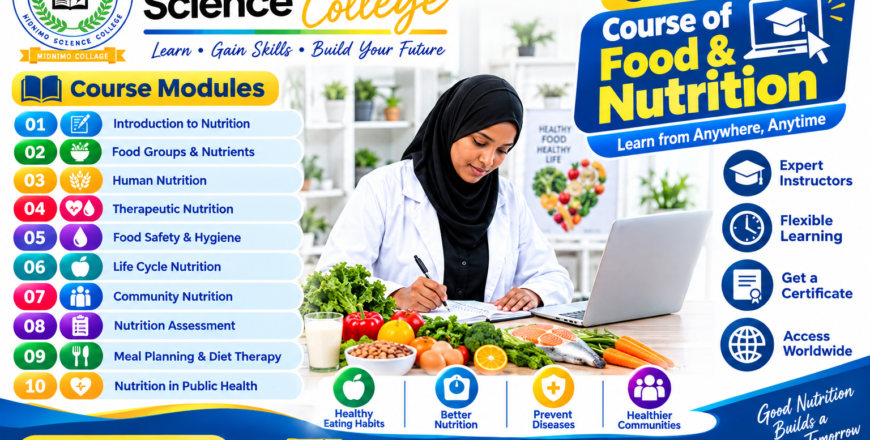
Course Name: Food and Nutrition
Course Category: Health Sciences / Nutrition
Course Level: Beginner to Intermediate
Course Duration: 12 Units
Course Language: English
Course Description: An introductory course covering essential nutrients, balanced diets, digestion and metabolism, vitamins and minerals, maternal and child nutrition, malnutrition prevention, and community nutrition interventions.
Target Audience: Health science students, nutrition students, community health workers, and individuals interested in nutrition and healthy living.
Learning Method: Lectures, study materials, and assessments.
Prerequisites: No prior knowledge required.
Certificate: Available upon successful completion.
Course Requirements – Food and Nutrition (Online Course)
-
A smartphone, tablet, or computer to access the online course.
-
A reliable internet connection.
-
Basic reading and writing skills.
-
Interest in food, nutrition, health, and healthy living.
-
Ability to access and study online learning materials.
-
Willingness to complete online assignments, quizzes, and examinations.
-
Basic knowledge of biology or health sciences is helpful but not required.
Prerequisites: No previous experience or specialized knowledge is required. This online course is suitable for beginners, health science students, community health workers, and anyone interested in nutrition and healthy living.
This online course is intended for:
-
Health science and nursing students.
-
Nutrition and dietetics students.
-
Community health workers and healthcare professionals.
-
Public health students and practitioners.
-
Teachers and individuals interested in health education.
-
NGO staff working in nutrition, maternal and child health, and community development.
-
Anyone interested in learning about healthy eating, balanced diets, and malnutrition prevention.
Target Learners: Beginners and individuals who want to develop their knowledge of food, nutrition, and healthy living. No previous experience is required.